Nov
7
Last week I attended a, let’s see if I can get this right, “California Milk Advisory Board Mom to Mom Event” in Modesto. Ketchum PR partnered with the advisory board to send a group of mom bloggers to California to promote dairy through a couple of farm tours and other events. I said yes to the invite because 1) it sounded interesting, and 2) I heard there would be, like, a shitload of cheese.
(Just so you know, they paid for our travel and fed us, but there was no financial incentive or blogging requirements or anything like that.)
We arrived in SFO on Wednesday and drove a long long way through a lot of brownish scenery to Modesto, where we spent the night. Thursday we spent most of the day touring two different dairy farms and talking to various folks before heading back to San Francisco and flying back home Friday morning.
It was a fast trip, made possible on my part only by my in-laws being willing to stay with the kids while I was gone (something I’d forgotten about: no daycare means no traveling without a fairly complex series of arrangements), and I could tell you about the people I met or the 10 trillion calories of dairy products I ate, but I think I’d rather tell you some of the things I came home thinking about.
One issue I was interested in hearing about is the use of hormones in dairy cows. Recombinant bovine somatotropin, or rBST, is an artificial growth hormone that increases milk yield in lactating cows. The commercial name of rBST is Posilac, and is trademarked by Monsanto.
(Thing to make you go hmmmmmm: Monsanto Inc. is the only company approved by the FDA to manufacture and sell rbST within the United States.)
The first farm we visited used rBST, the second farm didn’t. They explained this simply as a farm management choice, and I imagine that there’s a considerable amount of financial planning that goes into the decision to use rBST or not. rBST costs probably include the treatment itself, increased labor costs, feed costs, etc, which all must be weighed against the potential gain of milk production.
There is information out there that will tell you rBST is bad for human health. There’s information that says otherwise. There’s neutral informationyou can read in order to understand what rBST is and how it works.
The use of rBST is a pretty complicated issue that’s all tangled up in profit, environmental impact, marketing ploys, and opinion. I’m not 100% sure how I feel about rBST, but I haven’t gone out of my way to purchase the more expensive “hormone free” milk in the past, and I doubt I will going forward. I do feel a lot more informed about it now, and plan to continue reading up on it.
On that note, we did talk a bit about the “antibiotic free” label you sometimes see on milk cartons. What we were told, and what I’ve read since, is that any antibiotics given to cows are intended to treat a specific disease, like mastitis. Sick cows are separated, but on the off chance milk from an antibiotic-dosed cow is collected, it’s caught at the processing facility where all milk is tested before they accept a farm’s tank. If any tainted milk is found, the entire truckload is rejected and the farmer with the offending milk has to pay for everyone’s loss.
Bottom line is: ALL milk is antibiotic free, not just the kind with the fancy label that costs $4 more per gallon.
I was also interested in how the cows are treated on a dairy farm. I think I had generally imagined there were two main types of farms: the small independent places with cows strolling around lush green pesticide-free fields, and the giant corporate hellholes with miserable cows kept immobilized in their own filth.
These farms we visited were quite large, at least 800 cows on the second one and I forget how many at the first. These are the farms that are putting milk on your table, if you’re buying from a large cooperative like Darigold in the Seattle area. They didn’t really look anything like I’d imagined, from the owners (young, with small children) to the facilities (modern and efficient, but not remotely creepy).
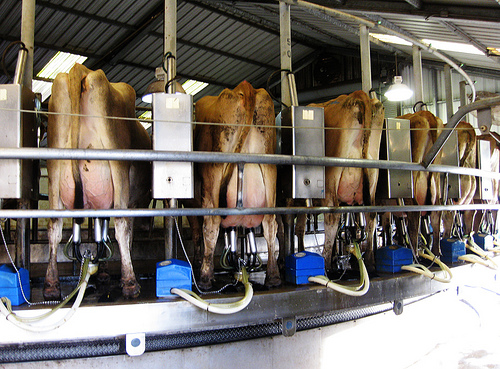
A rotating carousel milking station.
Both farms had cows in various holding pens, they weren’t roaming around a pasture or anything. Cows were together in large groups, but with plenty of room and in clean facilities. (Well, relatively clean. Cows do poop a lot, after all.) I did feel uncomfortable when I saw the calf pens, where the very youngest cows are kept. These are small individual containers and it’s hard not to look at a baby cow in there and think cage.
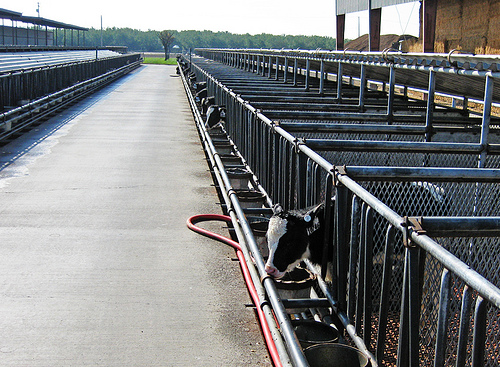
This isn’t done to be cruel, though. It’s about efficiency, like everything else on a modern dairy farm—disease prevention, improved nutrition and growth.
So, I don’t know. I prefer to think of baby cows hanging out with their mothers and wandering the fields, but the reality isn’t as awful as I’d imagined either. Cows are very . . . zenlike, somehow. You don’t get the feeling that they’re dying to get out of their holding pen and go for a hike, you know what I mean? All the cows we saw seemed quite content—mildly curious in the group of women frantically TwitPic’ing their every move, but generally just sort of there, doing their Cow Thing.
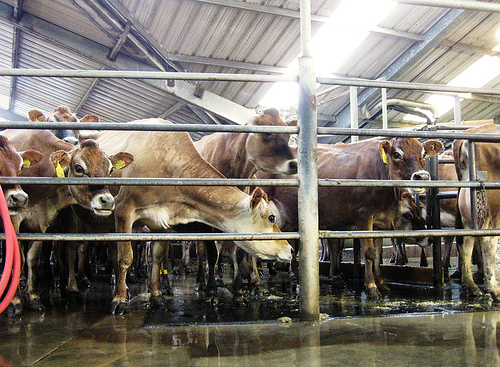
Cows entering a milking station. I liked these Jersey cows best, with their giant Bambi eyes.
Our PR team arranged for us to meet a couple of the young veterinarians that work with the farmers, and man, I enjoyed that. These girls are really passionate about their line of work. Vet schools are super hard to get into—I think they said there were only 27 nationwide?—and I doubt anyone goes into it for any other reason than a deep love of animals and farming. One of the vets showed us a slideshow of her typical work day (starting at 4:30 AM, lord), including photos of the awesome freaky strap-on portable cow-ultrasound machines they wear that look like something out of Ghostbusters, and that was very cool.
(As a kid, I was obsessed with those James Herriot books. I wanted to ask these young vets if they’d ever read them but was afraid it would make me seem Ancient and Crusty.)
We also talked with a California dairy farm sustainability expert, and while I can’t begin to remember all the environmental initiatives they’ve got underway, it was impressive. One interesting fact: since 1944, U.S. dairy farms have reduced the carbon footprint of milk by 63%. This is essentially thanks to all the efficiency improvements farms have made over the years, which results in more milk from fewer cows. Total dairy herds U.S.-wide used to be 25.6 million, down now to 9.3 million cows.
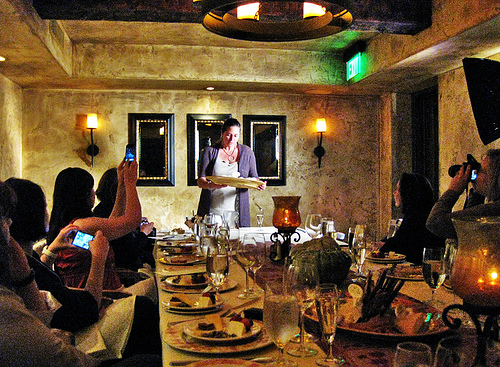
Overall, there were a lot of really fun things about the trip. There was the spectacular cheese-tasting dinner they treated us to on Wednesday night, hosted by a woman who was an absolute joy to listen to. There was the chance to get to know a group of bloggers I’d never have met otherwise, and of course the luxurious business of waking up in a hotel room with no diapers in sight.
The thing I appreciated the most, though, was the chance to feel a bit more connected to one of the foods I buy nearly every day. It was such a treat to meet the farm families and have the opportunity to experience a tiny bit of that lifestyle. It seems like a fair number of commercial dairy farms are open to tours, and I can’t recommend it enough if you have one in your area. Go check it out for yourself, ask questions, see how it all works. It’s a pretty amazing process.
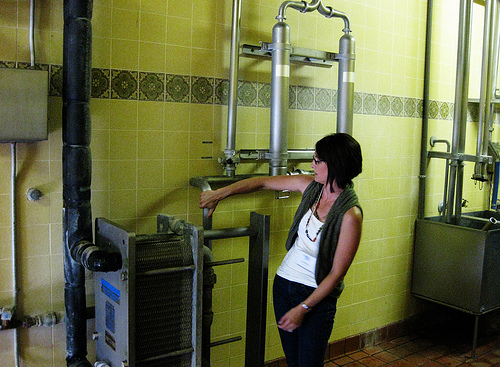
Ellen Durrer of the Durrer family farm, showing how milk enters a rapid-cooling area before going into a storage tank.
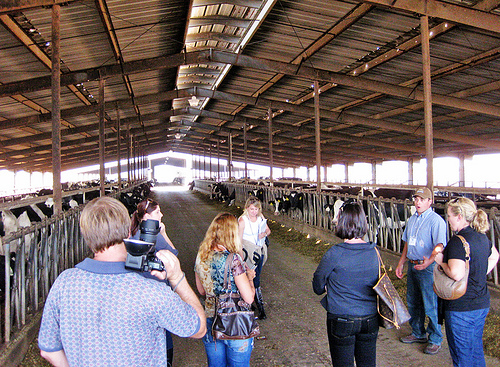
Chris Durrer talking about feed and housing.
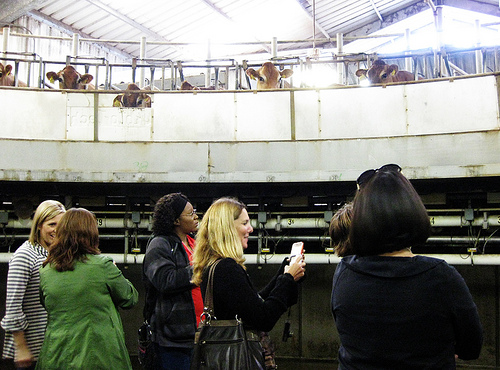
Bloggers: we will totally take pictures of ANYTHING.
Lastly, a tiny tidbit from the never-to-be-forgotten Wednesday night dinner: get yourself a gingersnap, crumble some Point Reyes blue cheese on top. Eat. DIE HAPPY.
Comments
98 Responses to “Dairy farm tour”
Leave a Reply


Great post! I love everything you write, but it’s extra exciting to read your take on something I am familiar with.
I really enjoyed working with the cows in school just for that reason (which, I LOVE this description)-they’re zen-like! (eh, the dairy cows, anyway…) And also possibly because I have the sense of humor of a ten year old boy…please show me one that would not snicker uncontrollably at a milking machine.
In college, ther was a cow that had a window put into it’s side to observe and study the way cow’s digestion system worked. As a photographer, I was once assigned to photograph the dear cow. It was pretty mellow too, but boy was there ever a funky smell coming out of the edges of the window. I will never forget.
I knew about the antibiotics on the label deal, but I still buy organic. With a young daughter, I don’t want any extra hormones wreaking havoc. But I guess I fall into the cautious camp.
Damn- I’d really like to edit that to say ” there was a cow that had a window put into its side…” groan.
I grew up working on dairy farms, and not sound weird, but this was very peaceful for me to read. Dairy farms are my happy place, and I grew up with no fewer than three (3) cows named after me, one of whom is still a pretty solid milker. Heh.
Having nursed 3 kids and having spent plenty of time hooked up to a milk machine, I feel for those cows. Not to mention seeing the word MASTITIS. I battled that twice, and it was AWFUL.
I’m from the camp of cows milk is meant for baby cows, not humans. I’ve always had an ick factor about cows milk.
I’m going to enjoy a glass of soy milk, which is probably filled with a bunch of crap I dont even want to know about.
Marketing Boards are clever. Appealing to mom bloggers is a great way to promote a product.
Re “This isn’t done to be cruel, though. It’s about efficiency…”
This is what Dairy Councils have been saying to counter negative publicity about factory farming.
I don’t think anybody goes into a business intending cruelty but efficiency in meat and dairy production does cause cruelty. Perhaps the farms you saw aren’t cruel or the cruelty is subtle (particularly if you want to believe cows are zen-like, i.e. don’t seem to mind or are able to rise above any discomfort they may experience in pen living), but factory farming is cruel.
Here’s an article on Monsanto.
http://www.vanityfair.com/politics/features/2008/05/monsanto200805
I hope you do keep researching.
I feel some weird kinship with cows, too. They’re so big and graceful and oblivious, somehow.
But still. Corporate farms make me sad; like they’ve bulldozed over the mom & pop farms of my Wisconsin childhood. And I won’t start rambling about my personal beliefs on the evils of artificial growth hormones; or hell, artificial additives of any kind in food products.
I think it’s cool that they’re open to tours, though; & would have been fascinated by those uber-futuristic milking parlors. Didja give the girls a scritch under their chin or behind their ears? I don’t think I could have resisted! =)
i had a great aunt that lived on a dairy farm. as neices and nephews we loved running around the hay stacks.and the field and I had an uncle who loved to squirt milk at us. and then there was the tea parties withraw milk.
Well holy cats! I shouldn’t be such a lurker – I live in Modesto! As in, I grew up on MY family’s dairy about 1/2 a mile from the Durrer dairy you toured. Glad you enjoyed your visit and the farm tours – to be honest, when I read that you were in Modesto I was bracing myself for some serious criticism of the city! :-) Thanks for being so kind!
Thoroughly enjoyed this post. very informative.
Great post! Very interesting to read.
I’m wondering how many people are going to post and bombard you about the evils of farming and using animals for our consumption, etc.
Lesley: I don’t think anything I said here is promoting a product, and neither did I say that cows cannot feel discomfort. I also did my own independent research on why calves are kept in hutches/pens.
I have absolutely no agenda here, I’m just talking about what I found interesting during the trip.
Sunny: I suppose it’s inevitable, but I hope they understand I’m not here to advocate the opposite opinion.
No one has to spend extra money on hormone/antibiotic free milk as long as they have a Trader Joe’s near enough. Win, win!
As a person who currently lives in a small, rual farm area, I thought this was a great post. However, I will spend extra $$ on the hormone-free milk for my kids.
@Kristianna-The closest Trader Joes to me is about an hour drive for me :)
Not that I’ve read it, but I’m going to go out on a limb and say Vanity Fair Politics wouldn’t be the FIRST place I’d think to go for an in-depth, unbiased, informative read on DAIRY FARMING.
Not knocking the post, but I recently toured a decent-sized New England family owned dairy farm which sells it’s milk to Agri-mark, an enormous farmers cooperative (Cabot is, I believe, their largest consumer brand). I have to say, it wasn’t anything like the pictures in your post – the cows were roaming around on pastures, calves with their mothers. It was pretty compelling. Nothing resembling cages to be seen. My understanding from the people at the farm is that this is the case primarily because New England does not have the sheer acreage to support factory farms, but nonetheless, I want to drink milk that comes from those cows.
One of the things I learned, and found interesting, was that on a factory farm, because they cows essentially produce their replacements, the cows have a set life-span. So if the average cow can produce milk for eight years, production values dictate that the cows are slaughtered after eight years, because the production lines can’t support an “extra” cow. On the smaller farms, a cow can be kept around for as long as it’s producing milk and calves can be sold.
I’m glad you had a nice trip. I have reminded myself that this is your blog, with your chosen content. I’ll continue to follow you for the posts I enjoy immensely, but this wasn’t one of them.
Re: “Cows are very . . . zenlike, somehow. You don’t get the feeling that they’re dying to get out of their holding pen and go for a hike, you know what I mean? All the cows we saw seemed quite content—mildly curious in the group of women frantically TwitPic’ing their every move, but generally just sort of there, doing their Cow Thing.”
“The Kingdom of Heaven, however, is with the cows.”
—Thus Spake Zarathustra, Friedrich Nietszche
(I wrote a whole paper in college based around the use of cow imagery in that book. I enjoyed writing that paper a lot.)
I have to chime in and say that there is a huge difference in the taste of regular old grocery store milk and milk from a grass-fed cow sold by a creamery. I do buy expensive milk for my kids, doesn’t have to be organic, but it does need to be from “grass-fed” cows which produce higher levels of omega 3’s naturally. I may reconsider once they are older but for now it’s important to us to feed our children the product with the highest quality to it (think Joe Joe’s instead of Oreos, meaning their diet is far from perfect). But the taste, I can’t tell you how much milkier and richer and creamier the grass fed, low temp pastuerized milk is. Just yum.
I, too, am glad that you enjoyed yourself, but I’m biting my tongue like crazy about this post. I’ve read you for ten years and will read you until you stop blogging, but yeah…there are so many things wrong with factory farming that I wouldn’t even know where to calmly start. So I won’t. :)
Where does chocolate milk come from? :)
I had no idea about the growth hormone issue. Diane was explaining to me the other day that everything is antibiotic free basically.
This was really interesting. I was just driving through Ohio last weekend staring at the farmlands and thinking how much I wanted to know what that lifestyle was like, day in and day out.
Why is the topic of milk so polarizing?
Thoughtful post. You saw what you saw and I believe you reported that honestly and with appropriate caveats based on your research.
Cows (and even bulls most of the time) are kind of zen-like. I live on ten acres in ranching country and to keep the grass down, and therefore reduce the risk of fire, I let a local family that runs a cow/calf operation use my pasture every summer. I’m a vegetarian myself (though not vegan), and I hate thinking about where they end up in the fall, but at least the calves have a pleasant summer in some of the prettiest country around and I’m helping a fourth-generation farm family hold on to a way of life that I think adds real value to the land they manage. And, selfishly, I love to sit on the lawn and watch them graze.
I can’t believe I’m about to say this, but there have been numerous taste tests done on free range/organic/local creamery milk and eggs, and the net/net is that while the color is different, the taste is … the same. Mostly, it’s all a mental thing, combined with the look (yellower, on both counts, ironically) and general feel-good about the whole thing.
GAH, I hate myself for getting into it, but there you go. I mean, buy it if you want to (I used to, when I could — the local creamery thing, that is), but sadly, the taste thing is kind of all mental.
As someone who pretty recently finished vet school, I can say with quite a bit of certainty that we all read the James Herriott books as well and loved them dearly. I still have all of them on my bookshelf at home!
If I was in the States, I’d pay the extra for the rBST-free milk. Since rBST cannot legally be used in Canada, I technically don’t have to… but I still pay more for organic milk. I know I probably sound like a chump, but my kids are little and I’ve often heard that if you can only afford to buy one organic type of product it should be dairy – something about pesticides being concentrated in the animal fat. I’m already grown so I don’t worry about it for me, but growing kids… well, I just don’t want to take the chance since we can afford the little extra it costs.
Oh and I too loved the Herriot books when I was a kid. And we had a couple of Jerseys at the time. Definitely the prettiest cow (though I’m surprised to see them at a large farm because they don’t give the most milk), and they give the most butterfat in their milk of any common breed. My mom used to make our own butter and ice cream. Good times.
Oh and jonniker – our milk tasted different. Much, much stronger and richer than store-bought. But then, ours wasn’t pasturized or homogenized and that makes a big difference. You can’t even buy raw milk now.
My husband suffered from hive/rash breakouts for the longest time. He was really itchy and would get large welts mostly on his arms, back and chest (sometimes legs). We could not figure it out for the longest time, even after three allergists. Finally, we were watching Red Eye and Dr. Baden mentioned that people who are allergic to penicillin (like my husband) sometimes breakout after consuming dairy products. This is due to the transfer of antibiotics through the milk. We switched to organic over a year and a half ago, and he has not had one episode since. I know farmers may think they are doing everything they can to prevent it, but some things obviously do get through. This was an interesting article though, I enjoyed it!
I am a respectful reader and admirer of this blog, and I appreciate the way you thoughtfully recorded and shared the details of your trip.
Cows were bred to eat grasses and though they can handle some grain, the huge quantities of corn and soy fed to feedlot cows wreaks havoc with their digestion, and many suspect ours too as we eat their meat and drink their milk.
Grass-fed meat/dairy is higher in Omega 3’s which we are sorely lacking.
And *perhaps* non-organic milk doesn’t taste different than organic milk, but there are countless other reasons to choose organic milk like not supporting the corporations who contribute toxic chemicals to soils and waterways, as well as our bodies, and especially our children’s growing bodies.
We are lucky enough to buy raw, organic milk from a local farmer. An animal who is able to roam on a pasture will always be my choice over one confined to a feedlot.
Respectfully,
Rachel
I live in Wisconsin – America’s Dairyland. My mom grew up on a dairy farm and I’ve always loved going to the farms. We have only one big corporate farm in our area and I’ve been there. I’ve also been to small, family farms where the cows are kept in the same barns they’ve been kept in for a hundred years. If you get a chance to go to one of these small, family farms, take it. I’m not saying the corporate farms are bad – far from it. It’s just a fun experience to see the different types of farms. I’m so glad you enjoyed your trip. It’s so nice to reconnect with our food.
@Jonniker – I will respectfully disagree with you. The non-homogenized grass fed cow milk (again, not necessarily organic) tastes better to me, it’s thicker, creamier and richer. I am a milk lover and can absolutely tell the difference just as some people can with artisian butters, eh?
This is a great post, I’m sorry it upsets you that people may have different opinions than you, Linda. It seems no one has an issue with you, but rather with the dairy industry. If I can learn something from your post or from a comment then you’ve done your job as a writer. Who wants boring posts lacking passion (from the people commenting)?
Interesting observations, Linda – thanks for writing about your trip! And I loved that you mentioned the veterinarian gals. My 30-yr old sister is just about to graduate from vet school – large animal specialty, particularly dairy cows. We read ALL of the James Herriott books over and over as kids and I bought her a new set of them when she got into vet school. :)
Move to Canada, Linda. If you posted it here, people would say sorry for no reason other than it’s what we do.
(Ignore the negativity. I know you know this but, yeah. Brush it off. :) )
Heather: I don’t mind one bit that someone has opinions they want to share (which may or may not be different than mine, I tried to keep opinion out of this post but I think people read things into it). I do mind people saying I am shilling for the industry, or as one person on Twitter accused, somehow magically timing my trip with this article: http://www.nytimes.com/2010/11/07/us/07fat.html.
Really, I could care less what anyone other than my own family eats or buys. I only meant to talk about my experiences and observations during the trip, not promote anything other than the fact that it’s interesting and possibly even useful to see where your food actually comes from.
I’m not sure why anyone would buy milk with rBST in it. That shit is just straight up bad for you, and besides, Monsanto is the devil.
Oof. Basically your visit to a dairy farm is in essence responsible for the growing obesity epidemic? Bloggers meet at dairy farm summit to plan a push on hidden government “eat more cheese” secret agendas, they just don’t know it? Or do they? Great conspiracy theory, but *Highly unlikely*.
Thanks for writing this, Linda. I believe that more information about where (and whom) our food comes from is better.
Another lurker chiming in to say hi, and wow…small world! I live just outside Modesto (hi Trish!) and have lived in this valley my whole life.
While I’ve never actually worked on a dairy, I was raised on raw milk from small dairies here and in Lodi. So yeah, I’m probably partial to organic; however, since I am not willing to own my own dairy cow due to their milking schedules (4 – 6 a.m.? WTF?!) I do buy my milk from a store.
My preference is Strauss milk (from a dairy near Santa Rosa, CA) because IMO, it is as close to the stuff “on tap” as anything I’ve ever tasted. It’s my understanding that the Trader Joes brand comes from this same dairy, though that has not been confirmed/denied by either Strauss or TJ’s.
ANYway…my point is that while everyone has a right to their own opinions as to what they eat…when it comes to commercial dairies, it is in their best interests to treat their animals right! While it may sound pithy, happy cows do indeed produce more milk. It would make no sense for the farms to mistreat their “cash cows” (*groan!*) and reduce milk output.
There is a dairy right down the road from my house and I swear, those cows have got it MADE! Every one of those cows is extremely well-treated. They have plenty of room so as not to be crowded, soft mats to lie on, misters to cool them down when it’s hot, and when it’s really hot (100+) they’re taken into an air conditioned barn!
Of course there will always be the few dairy operations that get the negative press. But for every one of the bad dairy farms…there are so many farmers that treat their animals with love and respect.
So glad you had a good experience here in our little corner of the world. Thanks for a very thoughtful (and impartial) article!
Yeah cows! I love cows, and some day I will have a Hereford bull, not to eat though.
Looks like a cool experience.
We recently visited an (organic) farm and my son got to see the cows being milked. Since seeing Food Inc. I won’t buy products with growth hormone. At a minimum, I want to buy organic. Once my daughter arrives, I will only buy grass-fed organic. I do notice a significant difference in taste. More importantly, I can’t shake a sense that there is a linkage between the way the standard cows are cared for in America (and the dairy and beef products we consume) and the disturbingly early puberty seen in girls in the last decade or so. I will do my best to limit those hormones entering my daughter’s body. That said, I love all things dairy, so I’m thankful we have several local farms that provide quality products.
Oh, James Herriot(t?). I’m not a vet, but I’ve read his books until they’ve fallen apart. I think Dog Stories is my favorite.
I don’t know what they put in SkimPlus milk, but it’s yummier than regular skim and it lasts twice as long. I’m sure I’ll die early. (Although reading this made me sorta want to check the label.)
I ate at Tom Colicchio’s restaurant CraftSteak a few years back and the waiter was really well versed (or *trained,* whatever) on the taste difference between grass fed and grain fed cows. We tried three rib eye steaks, one Wagyu, one grass fed and one grain fed. Wagyu was the best, but who can afford that on a regular basis? Next best was grass fed. But when it comes to buying meat (and dairy) myself, I go for what is cheapest. It’s 9:10 am and I want a steak. ha.
I don’t know about any of this, but I did see a link to your blog on msn where they were talking about dooce, and you not agreeing with her. I was like, hey! WTF?
Modesto! I grew up in Sacramento, and my grandmother grew up outside of Modesto. It is very flat and brown, isn’t it? I currently live in rural western Massachusetts, which is a world away from central California. I’m lucky enough to live near several small dairy farms, including one where I can walk into the barn and buy super fresh, raw, non-homogenized milk directly from their tank. It tastes fantastic, and it’s only $3 a gallon.
I’m a little leery of factory farmed food, but realize that not everyone has access to “boutique” milk and meat. That is really interesting that making milk production more efficient has also made it more green.
To Brigid above: Did you go to UC Davis?
super interesting!
I grew up in Wisconsin and knew several dairy farm kids. Wow, is that some hard, hard, hard work. Those kids had chores before school and after school until bedtime. They were some of the best people around. No time or energy to get into (much) trouble. When I get cranky, I remind my kids they could be out in a dairy barn at 4 in the morning instead of tucked in their cozy beds. My suburban snowflakes have it so easy, blah, blah…
Great post.
I think what bothers me about this is that while yes, Food Inc was transformative to many people (yep, I’ve seen it), there is a fundamental lack of understanding by many that it’s not necessarily the fault of the farmers that things are the way they are. Most dairy farms ARE family-owned, and they’re just doing the best they can. It is beyond challenging to make any money as a farmer, so the only hope many of them have is to join the Dairy Council to survive.
The small family farm/creamery is excellent, and those who have access to, and can afford to, should buy from it, because that supports your local community. However, our world is very big, and not everyone has access to such luxuries (and friends, it is a luxury, believe me), and in order for that model to work for EVERYONE, the world would have to be changed in such a profound way that is not even feasible. Factory farming is, for now, a necessity to sustain our way of life as a population. Period.
It’s a very confusing, multifaceted topic, and I get frustrated when it comes up, only because it is SO complex, and often the ones who fall under fire are the farmers, when believe you me, they are the last ones to profit from any of this. Milk prices, if you didn’t know, are heavily regulated, so their profits are inherently limited to an astonishing degree.
It’s a conversation only those in a position of privilege can have, really, but that’s an entirely different side to it. Because like I said, in our world, factory farming is a necessity right now, in order to be able to bring affordable milk to people who aren’t the audience for this (or any) blog.
Hmmm . . . this just reinforces my decision to buy milk only from Trader’s Point Creamery in Zionsville, IN. It’s local, the cows actually to graze in a pasture, the milk comes in glass bottles, and best of all, they let the cream rise to the top. I look forward to that cream every time I open a bottle. It’s like a taste of heaven.
Thank you for this balanced writing, Linda! Living in an area of the country that is agriculture based has been hugely eye opening to me. I am so glad to read someone talking about how complicated all our food decisions are.
(I’m also glad you had a good time!)
Linda, thanks again for a thought-provoking post. You are trying to do what’s best for you and your family. That’s not always easy. I enjoy everything you write!
As a city girl who milked Rosebud the cow once when she was nine and hasn’t touched an udder since I really appreciated this post, Linda. Thanks for telling us about your trip, and allowing us to comment. Also, I feel I should make a joke about touching udders here but nothing comes to mind :)
I’m mildly concerned about the hormones. Fortunately, we have a dairy that delivers and does not treat their cows with rBST. I’m not so sure I would go out of my way to buy this milk if it didn’t show up on my doorstep every week.
Just wanted to chime in with elembee123 about Strauss. Can’t get their milk here, but their vanilla yogurt is my favorite. Really creamy and tasty!
You’ve made me homesick. I grew up in very rural Wisconsin and our house was surrounded by farms. We were city-folk who bought in the country, but we had no farming ideals. I did get to spend a LOT of time at the neighbors, and one of their cow pastures surrounded our property on two sides. I loved the cows. When we’d cut the grass, they’d come up to the fence line so we could feed them the clippings. We had an apple tree near the fence line and they’d stretch their long tongues out to pull apples off the tree. When we’d light fireworks off from the back yard for July 4th, the cows would all line up by the fence where we were – I think they were attracted to the smell of the fireworks. We’d feed them veggies from the garden and fruit from our trees if we had too much or the tomatoes were too soft or bug eaten.
Zen-like creatures, indeed.
The neighbors would drink milk straight from the cow. It’d still be warm and not be strained or anything. I never could drink it (I was so city-fied).
It’s frighteningly sad how many family farms in my little home-town are no longer in existence. Too much work, too little money, too much competition from the corporate farms. Kids don’t want to go into the family farming business.
When you have this many people that place that big of a demand on the food system, it’s hard. And farmers do what they can. They have laws and regulations and a life they need to work with. Farmers are really dedicated to their work (think about what hoops they have to jump through to go on vacation).
I liked your post. Thanks. (Sorry for rambling)
Jonniker brings up some very good points-and I can’t stress enough how hard these farmers work. No one would do this kind of all consuming job unless they had a real love of the animals, and commitment to the industry.
Way back in the early 1980’s, I had every intention of going to vet school, until I found out that it was harder to get into vet school than medical school. Loved the James Herriot books, even visited his museum in Thirsk when I was in England. Wonderful!
Just an interesting aside on the use of rBST-my girlfriend works at an organic New England creamery and always comments on people at the farmer’s markets being shocked at the amount of veal that they sell.
However, without using rBST, the cows need to be impregnated more often, which can result in baby MALE cows, which are useless for dairy production and then need to be slaughtered.
jonniker – thanks for your words, you’ve pretty much summed up how I feel exactly. It’s a nice thought that we can all walk down to the local dairy farm and pick up freshly squeezed (squeezed? pumped?) milk, but the reality is in order for America to keep up the production levels needed, this model is what works – period. You’d have to almost knock down every building in America and replace it with grass to get that kind of production.
I really enjoyed this post Linda, I thought it was very well written and I learned some things (especially about the antibiotic thing, I give my daughter regular store bought – gasp – milk). I worked at a feed yard once (y’all don’t even want to know what that is) and it opened my eyes on meat production in America.
Linda thanks for posting this. It’s good to see it through your eyes. When information comes from a trusted source such as you, it’s always so much more helpful to process. Because I know you’re unbiased and you’re a mom who only wants what all other moms want – healthful choices for our kids and our loved one.
Chris: Yes. Or, as I said to Linda, we’d have to enact some sort of drastic population control, like China. Oh, you want your grass-fed beef and small-town creameries for everyone? Excellent. Now here is your ONE child. Or, alternatively, we could all become vegetarians, because we all know the math of how much open-field grass it takes to feed one cow, right?
I’m not saying it can’t be improved, because everything in life can be. I just dislike the smugness that comes around food topics like this, because it fails to take into account so many things, when in most cases, it is one’s position of privilege that enables such choices.
First off, I’m glad you got to visit a working dairy farm. It’s awesome that you got a chance, like you said, to see where your milk comes from. I grew up on a dairy farm in WI, right in the heart of “America’s Dairyland”. I’m going to apologize in advance for the length of this post.
My dad bought the farm from his dad who bought the farm from his father-in-law. We’re exactly the small-town farm family that you’d imagine. When I was a kid, we milked around 55-60 cows, in a stanchion barn, where every milker had to be put on, kneeling next to the cow. Today we milk around 500 cows, in a 12 x 12 parallel parlor with the cows living in a freestall barn similar to the one pictured in your post.
It is true that a treated cow’s milk is separated from rest. This milk should never make it to the creamery. We had to dump a load of milk once, because a treated cow was mistakenly milked into the tank and the entire tank had to be dumped down the drain. My dad works very hard making sure that no antibiotics/treated milk reaches the tank, usually milking those cows himself. rBST is such a touchy subject, but as far as I know, there really is no testing available to tell whether or not a farmer is even using it. Even if a creamery states that their farms don’t use rBST, they really have no way of knowing for sure.
As far as the animal cruelty goes, well, in my experience, I’ve never seen a farm that would qualify as cruel. I also work in the dairy industry, for a contractor, and pretty much every barn we build is geared around cow comfort. From ventilation & sprinkler systems, to mattresses in the stalls, to the feed lanes, it’s all about the cows. Cows WILL NOT give milk when they’re stressed.
The dairy industry isn’t an evil conglomeration set up to get rich while making the public sick. As Jonniker said, milk prices are tightly regulated, and I’ll be the first to say that farmers aren’t rolling in the dough. It’s a little unnerving how quickly people will jump on the bandwagon without any REAL experience on a farm. Find a farm near you, and visit. Most farmers I know would welcome a tour group with open arms. We’ve got nothing to hide.
Well, I found this fascinating, and I am sure I am not along in envying you that cheese-tasting dinner. Bring on the cheese, man!
Also, in my purely anecdotal experience, I have found that Horizon Organic milk products taste insanely good. Their milk and cottage cheese are out of this WORLD. Possibly they are loading it up with sugar or crack or something, I don’t know, but damn.
I forgot to mention in my other comment, I lived and worked on a friend’s farm one summer, and one of my jobs was milking the one cow they had. That is the milk they drank, and all they did was strain it, and put it in the fridge. This is only my personal taste, but it was the most DISGUSTING thing I have ever tasted, and I would choke it down at supper time.
That experience sent me screaming into the arms of skim milk, and I have never looked back.
Someone may have mentioned this already, but I don’t notice that the hormone-free milk is more expensive. Yes, the organic kind that promotes it big on the container, but I almost always buy store brand and most of them have a little seal that says “rBST hormone-free” (Target’s brand, for instance, is hormone-free). I’m in Colorado, and it may be regional, but it’s worth a look next time you’re browsing milk.
It’s not the farmers…it’s our government. Read the Times article Linda linked to and tell me the government isn’t up to no good most of the time…and we, the people, are the ones who suffer. The best comment on this post was by Lesley who is encouraging us all to keep researching. If Linda’s post sparked some interest, do some more research for yourself.
I’m not exactly on board with the “government is evil” tone Ellis takes, but that NYT article is scary. It really underscores that *when you can*, you should consume locally grown and produced foods. Good advice for all kinds of reasons.
Linda, this wasn’t my favorite of your posts but I respect your right to write it and to pursue your living as a writer. In general, I think the discussion you stimulated has been very interesting, even to one who does not eat cow products (except for a little butter now and then). My avoidance is due to the fact that my own experience, and that of the nutritionists I have read, is that cow’s milk is really best for baby cows and is the hardest of all animal milks for the human body to absorb and use.
I suffered from chronic ear, sinus, and throat infections until I stopped consuming cow dairy. From what I understand, a lot of people (especially kids) have the same issues. I do consume goat and sheep cheeses, but their price (if nothing else) keeps my to small amounts. Parents take note: if your little ones are constantly sniveling the green stuff, cut out cow dairy for a month and see if it clears up. I use soy for cereal, lattes and frozen treats. I know some people don’t tolerate soy well–and the soy industry has its own problems. We live in too compliated a world, don’t we?
I would like to thank you very much for sharing your dairy experience! We really enjoyed having you as our guest here at Durrer Dairy and are glad that we were able to help share a thing or two about our lifestyle.
Re: Kate – “One of the things I learned, and found interesting, was that on a factory farm, because they cows essentially produce their replacements, the cows have a set life-span. So if the average cow can produce milk for eight years, production values dictate that the cows are slaughtered after eight years, because the production lines can’t support an “extra” cow. On the smaller farms, a cow can be kept around for as long as it’s producing milk and calves can be sold.”
While our 650 milking cow operation may seem to some as a “factory farm”, we are family owned and operated, most specifically by my husband and father-in-law, with an additional 8 employees. Your comment re: “on the smaller farms a cow can be kept around for as long as it’s producing milk and calves can be sold”, holds true for us as well. As long as she’s producing, both calves & milk, she will remain under our supervision and care. Once she is no longer producing either calves or milk, which come hand-in-hand, she will be sold, as our specialty is raising cattle for the production of milk.
I’m enjoying the comments from all sides of the spectrum and Very Much encourage Everyone to continue the discussion about Where Your Food Comes From! You are ahead of the game on many of your fellow citizens who are content to believe that their food/beverages come from the grocery store or restaurant and the discussion ends there. Thank you for your interest!
I’m just commenting on the cheese here, so hopefully it’ll be a nice change of pace. :)
Linda, the next time you are in the Bay Area, let me know. I, too, am an avid cheese lover and it would be my honor to expose you to some of the more amazing California cheeses. Point Reyes blue is heaven, yes, but honey, you were barely through the pearly gates with that little piece of mold.
And if you happen to be in town on December 5th, we can go here http://www.cacheeseguild.org/index.html and pretty much eat until we’re somehow high.
Luv,
Bianca
Holy shiz, Linda! You sure did start a conversation here. I read the post before many had commented, and thought it was an interesting interesting and informative. I certainly did not expect it to illicit such an emotional response in so many people. I took a dairy farm tour in Las Cruces, NM about 10 years ago, and my most vivid memory is of my almost 2 year old son, Riley, repeating (it seemed like hundreds of times), “Dows poop” (cows, poop). I just kept saying, “Yes, Riley cows do poop (A LOT)”
I’m a pretty uneducated consumer, and I only know enough about hormones and antibiotics enough to be scared of them. I used to buy organic milk for my kid and then a friend mentioned that she can’t fathom spending that kind of money for milk, but she does always buy milk at costco since it’s rBST free. I checked and sure’nuff, it was. I’ve checked at a few other grocery stores too, and I’ve been surprised that a few also were (I think they were Wegmans and Safeway?) so I can still buy regular milk at regular price and it will at least be free of ONE scary thing.
Jonniker at 10:53-”I’m not saying it can’t be improved, because everything in life can be. I just dislike the smugness that comes around food topics like this, because it fails to take into account so many things, when in most cases, it is one’s position of privilege that enables such choices”–YES!!!! I love the way you worded that!
I love that milk prices can be regulated but getting any meaningful regulation of health insurance companies is deemed impossible/unsconstitutional/unamerican.
Yay lobbyists!
I also think Monsanto is the devil, mainly because I hate how lobbyists control Washington, and Monsanto clearly has some killer lobbyists.
I’m lactose intolerant.
Ellen – so is that not true in general, then, or just not true for your farm? Not that you can speak for all farms, obviously.
Strictly speaking, I actually can’t drink the milk from the farm I visited, however much I would like to, since it’s only used for cheese.
@Kate – In general, it is not true that a cow would “sent down river” simply because she had “replaced herself” by bearing a calf. Obviously I can not speak for US dairy farmers, but all other reasons aside, a dairy farmer invests approx. 2 years into a heifer (female bovine prior to giving birth, only lactating bovine are technically “cows”) only to sell her for a Very Small fraction of his investment. To say the least, it would be counter-productive. The average cow will stay on a milking facility for 5-8 pregnancies, which would put her at 7-10 years old. Think of cows in terms of dog years and that doesn’t seem so “young”. I hope this helps.
On a side note, the term “factory farm” is often subject to interpretation. Though the average CA dairy herd size has increased in terms of the number of cows per facility, 99% of these CA dairy farms are Still family owned and operated, just as ours is. My husband is a 3rd generation CA dairy farmer, with both of my father-in-laws parents originating from Very Small family dairy farms in Switzerland. My own father is a 4th generation CA dairy farmer, his family also originating from a small Swiss dairy farm. The remaining 1% of CA dairy herds, are University and prison facilities, for educational and honor farm type experiences. While in college, I toured the dairy farm at the prison in Lompoc, CA. At the time they were processing and packaging their milk to be distributed to other prison facilities. My husband and I attended Cal Poly, San Luis Obispo, and one of my sisters attended UC Davis. Both schools have on campus dairy facilities to give students hands on learning experiences.
Intended to say “I can not speak for ALL US dairy farmers…”
First of all, thank you for writing this. I know everyone has an opinion about the choices they make based second hand information and having the first hand information is definitely useful in making my decision as a consumer.
That being said, there are a few things bugging me in the comments. I don’t buy the idea that people should buy cheaper milk because they are pressed economically to do so. It’s one thing if they don’t believe the milk will harm them, but politically speaking and in the long term, they might not be acting in their best interest. Also, as a proponent of small farms who has seen a couple places disappear because of regulations favoring larger farms, I am hoping that some of those small farms get some face time and some advocacy on their behalf because they are producing a healthier and more sustainable product. That is just my opinion.
I don’t know that there is anything that is crueler than the dairy industry… What does it take to have milk and cheese? The cows must be artificially inseminated – Often a painful procedure done with clumsy, inexperienced “farm hands”. Then after 9 months- Once the calf is born it is taken from the mother within a day or less. Many newborn calves go straight to slaughter as “bob veal”. The other males are sent to isolated confinement to become “rose veal” at 4 months old. Of course the mother too, after a short miserable life gets sent to become “hamburger”. All this – So unweaned humans can steal the milk from babies… With so many healthier plant based options for “cheeze” I just don’t understand how anyone can approve of this inhumane practice to such gentle, innocent beings. Try vegan. It’s not that hard and it’s definitely the right thing to do! :)
I was glad to see some folks bringing up the fact that lots of places sell milk with no hormones for good prices… they just don’t advertise it. I buy our milk at Target and their farmers pledge to not treat their cows with rBST. About a year ago I noticed that my 6yo son had what seemed like B.O. all of a sudden. It was quite shocking. But just as soon as it came it went away. Then several months later I noticed it again. I did some googling and read that it can sometimes be caused by the hormones in milk. I realized that we had picked up our milk from the corner gas station that week and it indeed was not rBST free. After a few days back on our regular milk, the B.O. smell was gone. That was enough of to make sure I don’t stop at the gas station for milk anymore!!
Okay, just two more things:
Buying organic isn’t always a function of privilege, it is also a function of choice and priority. I buy organic food whenever possible because that is a priority to me. I also shop at thrift stores and rarely buy new clothes, I don’t have cable TV or buy a lot of high-priced packaged food (much to my kids chagrin). The local, raw milk I buy is $4/gallon. I frequently make 4 quarts of yogurt from that one gallon, which saves a significant amount of money.
Also, the notion that because we deserve cheap food and unlimited access to it comes at a price. The hidden cost of cheap food is environmental degradation, animal suffering and our own worsening health as Americans. And Jonniker is right, there isn’t enough land to support grassfed cows at the rate of consumption we’re used to. Maybe, just maybe, we’ve been consuming too much.
@6512 and growing, Seriously? Seriously? Consuming too much milk? You know that smugness that jonniker was talking about? That’s it right there in a hand basket. We all make choices to buy or not to buy. I think what irritates me is there are people in this world that honestly can’t afford $2 gallons of milk – let alone $4 gallons.
Even the “cheap” milk isn’t cheap here. Here’s a screenshot of regular/organic gallon prices, at least from one online grocer:
@Chris – Yes, seriously. Where would we be if we didn’t stop to think about the amount of resources we continue to consume, the sustainability of said resources or lack thereof, and the bleak situation(s) that might result if we don’t pay attention? Oh wait, we’re already there. This response is not meant to address Linda’s post, or the fact that many people can’t afford a $2 gallon of milk, which is true and sad and a whole giant blog post unto itself. I just think that it certainly doesn’t hurt to point out that we’ve been approaching these issues with downright disregard for our planet and our future well-being. We would all be better off doing a little bit more critical thinking instead of continuing to live our lives with our heads in the sand.
Linda,
This is my first time here and I appreciate your venturing into these muddy waters. I learned a lot form the comments about various thing.
I am a rather educated food consumer but I cannot even remember the last time I bought cow’s milk. It makes my kiddos sick (food sensitivities). But there is definitely a link between earl puberty and all the hormones in our food. We use almond milk but if we ever did go back to regular milk I would spend the extra $ on the organic grass fed. When you one considers how much milk kiddos drink…it really is worth it. i mean if you don’t spend your $$ on what goes into your body what should you spend it on? And I am not directing this to you Linda but just giving the other readers more food for thought.
Kim: I hear what you’re saying, and it’s obviously an individual choice, one I would never judge someone on one way or the other.
A different take on the early-puberty issue: many scientists believe this is actually caused by escalating childhood obesity trends. As far as I can tell from my own research (and please, feel free to correct me), no link between hormones and early puberty has been established to date.
“This isn’t done to be cruel, though. It’s about efficiency…”
Take a tour through a few more barns, on a day when they’re not set up to receive women folk and you’ll see what genuine heifer-shit this is.
You want disease prevention, put those cows out on grass. Rotate their pasture. Don’t house them shoulder to shoulder, on top of their own shit. They tell you they only use antibiotics in a case of mastitis? Cute. They shoveled out those stalls and washed their cows up so they weren’t knee deep in crap? I guess you girls all got your hair done that day, didn’t you.
I live in farm country, I farm myself. I know personally countless dairies and the frank torture that the vast majority of the animals go through.
I can tell you have never attended a livestock auction and seen how the unwanted MALE calves are treated. It is truly disgusting. The ones not “lucky enough” to be stuck in a space they may be able to kneel in but not lay down. That is NOT necessary.
This little glimpse you got Linda, it is in NO WAY representative of the majority of industrial dairy barns. I hope you realize that you would never be allowed in most of these barns, that your “research” online is most limited.
You think you enjoyed the Zen like presence of cows stuck in confinement? You should see what cows and calves look like frolicking on green pasture. Now that would be a sight to blog about.
Btw, there is a sharp distinction between organic, grass-fed milk and hormone-free milk. The former frequently comes with a high premium AND only recently (like, in the last year) had actual guidelines as to what organic really meant — as of this year, cows are required to actually graze. In years past, companies (including Horizon, one of the most popular brands) only provided “organic feed” (whatever that means) and occasional *access* to green pastures. Now, there are grazing time requirements, among other things, that make organic milk organic.
It’s worth noting, too, as anyone who reads Michael Pollan can attest, that organic … kind of doesn’t mean much in some areas. Organic farms are employing many of the same factory-level practices that conventional farms do. So as I said, if you really want the real deal, go to a small, local (like, with in driving distance) farm and get your shit there. Otherwise, you’re supporting some small cog in a big machine anyway.
There is also a significant difference between a sustainable farm and general sustainability for the population at large. Those of you discussing how important grass-fed milk/beef/etc is, should also be seriously considering the environmental impact the rest of your habits cause, including consumption of — you guessed it — milk and beef, as well as how many children you have, whether you’re willing to give it all up and move to a high-rise in the city (less impact! Give up your land AND your kids!). If you really want to talk about that part, give Bill McKibben a call. I’m sure he’d be glad to discuss it with you at length. So would No-Impact Man.
My point is this: It’s easy to be caught up in this one issue, when there is a giant, ginormous world out there that this is but one small part of, and it’s an individual choice, and I assure you, not one of you has any right to be smug, preachy or indignant about this, because it’s extreeeeemely complex.
Oh, and Scott, I’ve been to many a livestock auction, grew up in farm country and I don’t think you can speak to the majority of anything, you know? That’s your experience. But like you, I lived it, and had a totally different experience.
And I’m out. And genuinely frightened at my accrued dairy business knowledge.
Milk from organically raised unicorns, collected only after the appearance of a rainbow: it’s expensive, but so worth it. My kids can fly now.
@ Scott – “Take a tour through a few more barns, on a day when they’re not set up to receive women folk and you’ll see what genuine heifer-shit this is… I live in farm country, I farm myself. I know personally countless dairies and the frank torture that the vast majority of the animals go through.”
If you actually look at our family blog, linked to on the post above, you will see that the women who visited our facility saw it in Exactly the Same condition that it is in Every Single Day of the Year! This is our life, and our livelihood. We have been raised here and are raising our children here.
You can walk into any type of business and turn around and walk out in complete disgust of the conditions. While this may hold true for some operations, they are not the majority – they are the exception, not the rule. If the conditions are that awful, I highly encourage you to report them to county officials so those of us who take this business seriously and whole heartedly are not lumped into these types of generalizations.
Scott, I can appreciate that you are speaking to your experience but commenting that these women done got their hair did negates your comment. It was demeaning and ridiculous.
As some one else who lives in the Northwest–land of the smug food asshole–but grew up in the Midwest with actual farmers I am impatient with people who can’t look at the big picture. There is always some one who thinks everyone should only buy organic (ignoring that the organic designation is semi-meaningless or any economic issues) and some one else will comment that everyone should be vegan and well. . .
The one thing that I think is fantastic about the organic food movement and the local food movements is that people are paying attention to farmers. It is almost too late–most family farmers are gone. Even organic farmers are often big corporations. But if you are lucky and can hit a real family farm or dairy farm the food is amazing. But, the genie is out of the bottle, we have put efficiency into our food and I don’t know how we can take it out again. We don’t have the farmers or land or ability to feed people without those efficiencies.
Stumbled here from Classy and was totally taken in by James Herriot. LOVED those books. And just yesterday I found an old copy at my goodwill and snatched it up, in the hopes that my kids will one day pick it in our house at random and be sucked in, too.
Great discussion. Poor Scott. ;) Great cheese! I totally would have gone for that alone.
Thank you for this post, Linda. It thoroughly convinced me to go vegan.
My grandfather was a dairy farmer, he sold his farm because none of his kids wanted to go into the business (hard work, no vacation, no sleeping in), so it warms my heart to see a family farm like the Durrers. And while I’ll always be partial to Holsteins (my grandpa’s cow of choice) those Jersey’s are so sweet.
I’ve been to large scale family owned dairies in Nevada and Arizona when I was in my pre-teens and felt like my mom totally screwed me by not staying in the business. I so wanted to be a farmer when I grew up.
Thanks for writing about this, Linda. And thanks to Ellen Durrer for bravely posting in the comments section.
To the ‘early-puberty issue’. I have only just begun to look into the research. However, my daughter is heading toward 14 and has yet to start her period (God help me if she finds out I said that for the whole INTERNET to read :) She is just over 100 pounds at 5′5″. She has had nothing but the least expensive cows milk available (we have 5 kids and, idealists that we are, chose education as our $ maker). No early onset puberty at our house. Just sayin’
After reading this, I was curious about the milk that we use, so I checked.
I most frequently buy our milk at Walmart (their Great Value brand) as it’s $2.38 a gallon or so. I haven’t been home to check the label, but did read an article from 2008 where Walmart was now only getting it’s milk from cows that haven’t been treated with rBST. So, apparently you can get rBST-free rather cheap.
Yes, it’s from the evil Walmart, but I can’t pass up milk at $2.38 a gallon when my local supermarket sells it at almost $4.00 a gallon. If I was buying a gallon a month, no big deal, but I’ve got a 3 year old and a 5 year old and we go through a gallon every 2 or 3 days.
Linda,
Wow.
I’m sorry you’ve fallen to the propaganda. You did profit from this trip, and now you ARE promoting an agenda, a corporate dairy farm agenda, with your description. They scratched your back, and now… well, don’t pretend otherwise.
Several people have mentioned Strauss, so I thought I’d share one blogger’s trip to their dairy. http://fakeplasticfish.com/2009/10/learning-where-my-food-comes-from-a-field-trip-to-straus-dairy-farm/ As you can see, there are places where cows get to roam free.
Linda, I respect you greatly as a mom and as a blogger. I consider myself a ‘fan.’ I have to put myself into the camp of followers who found your post a bit disturbing. Hm, maybe I should clarify. For the most part I found your post educational and enjoyable. I think what disturbed me was the parts where you presented the issues (antibiotics and hormones) in a way that simply dismissed the validity of even bringing them up in the first place; this made me feel like you’d swallowed party line instead of reaching conclusions on your own. I’m not saying you *did*, just that you came across that way, a bit.
Your post certainly served as food for thought. I think that something is always lost when production is increased over a certain point. This is tricky because sometimes I think those tradeoffs are necessary (it’s important to feed everybody) but at the same time the world we live in takes that necessity and twists it (we aren’t just producing enough milk to meet people’s needs, we’re building markets and trying to maximize profits…which is, of course, a matter of survival for the dairy farmers, I’m not pointing the finger at them). Given the world we currently live in, where large-scale, streamlined milk production is our current reality, then I’m glad to know that there are producers like the ones you visited.
I happen to be in a position of privilege with regards to my ability to access and afford organic and sustainably farmed foods, but I think I read my privilege differently from some of the posters on here. Because I can afford it (with some sacrifice required), I feel compelled to support the best-possible forms of production and consumption. Rather than argue “it’s not available to everybody so therefore the lessons are irrelevant,” I’d rather struggle for ever-more inclusion of sustainable and humane practices. (Hm, I think this might be rambling now — blame the fussy infant. I’ll jump off the soap box.)
I suppose the truly ironic thing about my stance is that I don’t really like the taste of organic milk. It’s…well, it’s foreign to me. I buy Strauss cream, but it’s TJ’s all the way for milk, eggs, etc.
I enjoyed reading your honest post and the many comments you received. I’m a dairy producer in Ohio who grew up on a dairy farm in California. I love to share the story of our farm via my blog @ http://www.thedairymom.blogspot.com/. Check out my post about the difference between organic and traditional milk @ http://thedairymom.blogspot.com/2010/06/whats-difference-between-traditional.html. There’s lots of misinformation about agriculture among consumers. I appreciate you taking the time to visit a dairy farm and would encourage anyone who has the opportunity to visit a farm and meet the farm families who produce the food you enjoy.