
Dec
29
December 29, 2006
When JB’s brother Joe was in high school, his class held a career-focused activity where each student had to shadow a local business for the day. Joe, wise-ass kid that he was, decided it would be amusing to hang out at the funeral home.
Funny how the smallest decisions can change your life’s trajectory. That summer he started working for them on a part time basis, washing hearses. Later, he was apprenticing with the owners. He eventually went to mortuary school, and has now been working as a funeral director for over ten years. He’s also picked up his bachelor’s degree, and spent some time teaching mortuary science.
Joe’s the only person I know who wears formal clothing every single workday: he dresses carefully in dark suits and ties. His job involves talking to grieving families, arranging services, driving out to pick up bodies, and preparing bodies for viewing.
I’ve always been curious about Joe’s job, and at family get-togethers I like to pester him with questions, mostly when his parents aren’t within earshot and I can ask awful things like, “Sooo…have you ever had to put a head back on?” (answer: yes, from a suicide who used piano wire to hang himself with, and Joe had to put a broomstick in the neck to re-attach the head).
On a recent weekend we were staying at Joe’s house, and as expected (he’s usually on call through the holidays) his phone rang. He told us he had to pick up an elderly woman’s body from her home and do an embalming, then he’d be done for the day.
I hesitate for a minute, then ask.
“Can I watch?”
I think Joe is pleased to have someone be interested in his work, because he agrees right away. I can’t come on the call itself, but he gets consent from the family for me to attend the embalming, and once the body is on the way to the funeral home Joe comes back and picks me me up.
I follow him to the driveway, where a van is parked. “Why no hearse?” I ask, vaguely disappointed.
It turns out the hearse is mostly used for funerals, not for picking up bodies. It seems people feel funny about seeing a hearse pull up to a house, so Joe drives a nondescript van. He calls it the Taliban Van. “Can’t you picture this thing filled with rocket launchers and guns?” he says.
It rattles and clatters, it’s metal and empty in the back (except for one gurney, holding an ominous shape covered in cloth). The van typically only contains a few gurneys and what Joe describes as hazard gear: materials used for cleaning up after a messy death.
I ask if cleaning is part of the job. Joe says no, but that he does what he can. “I think of Grady’s death,” he tells me. He’s talking about a friend in high school who shot himself while playing Russian Roulette one winter morning after a night of drinking. He had died in his bedroom, in his mother’s house, leaving heartbreaking evidence of the bullet’s fatal damage behind as his body was carried away.
I had never really imagined the grim emotional reality of death’s impact on someone’s carpet fibers. The unfathomable task of cleaning your child’s blood off the walls.
“I always clean after a suicide,” he says. “For most deaths I usually try and clean a little. Sometimes we take the linens the body was lying on and dispose of them for a family.”
I try not to think of these various linens and their various soils, and fail.
We arrive at the funeral home, the Taliban Van shuddering to a halt outside the double doors. Joe unlocks the building and we walk inside. A crematory sits directly in front of the entrance, and two walk-in coolers, used for storing bodies that have not yet been embalmed, are on either side. Joe swings open one of the cooler doors for a moment and I see a couple of draped bodies in the back. He also cranks open the crematory door to briefly show me its hellish innards; a blast of dry heat comes out and I see piles of ashes sitting back there.
We walk up a ramp and we’re in an employee area with a dry-erase board documenting the calls and funerals. Joe hands me a white medical-looking robe, which I nervously zip shut. He asks if I’m ready, opens a door and beckons me inside, and suddenly I’m standing next to five dead bodies.
Five. Dead. Bodies.
I’m in the prep room, the work area where the embalming is done. It’s narrow with bright lighting, there are six fluorescent rectangles in the ceiling. At one end of the room is a sink, some equipment, and a white table. On either side of the room are five gurneys, lined in rows. On each gurney lies a body, draped in a white sheet, head exposed.
They all appear to be elderly. Their hair is stringy and white and their faces are pointed towards the fluorescent ceiling and there is a thick, choking smell of sweetness and chemicals in the air. Their eyes are closed and their skin looks waxy and I cannot help thinking of horror movies and zombies and creaking limbs that move even after life is long gone.
I stare and stare and when Joe says he’ll be right back, I chase him out of the room, practically trampling on the back of his dress shoes. “I’ll just . . . come with you,” I say, and Joe laughs.
I follow him back to the Tali-Van and he rolls the body out, using a collapsible gurney. The body belongs to an old woman who died under hospice care at home, so picking her up was a straightforward process. Sometimes Joe has to go to hospitals or nursing homes, sometimes the police need to be involved when he takes a body.
He pushes the draped, rolling gurney back up the ramp and into the prep room. This time the bodies aren’t quite so startling, and I take the time to look more carefully at each of them. Each of their heads is carefully propped on a plastic block, their hands crisscrossed under the sheets on their chests.
Joe tells me he has a job for me, and I blanche before I see the iPod in his hand. “Pick out some music,” he says, amused. I choose Bob Seger. “Like a Rock” starts playing through some unseen stereo and Joe cracks his knuckles. “Ready?” he asks.
Truthfully, I’m not completely, 100% sure, but I nod and furtively zip my robe a little tighter.
Joe rolls the gurney containing — oh, let’s call her Lady X — close to the white prep table at the end of the room. He squirts a gel-like substance on the table, which he tells me makes it easier to slide the body, and cuts Lady X’s clothes off.
With practiced movements he slides Lady X from the gurney onto the table and she tumbles slightly, her limbs kind of collapsing around her, and my brain is helplessly stuttering DEAD, DEAD, that’s a DEAD PERSON, and now there she lies, her naked body white and sagging.
Joe makes note of her jewelry, scribbling in a book. “Yellow bracelet. Yellow watch. Yellow earrings.” I ask why he doesn’t list them as gold, because they clearly are, and he says that funeral directors have to be careful not to make assumptions about the value of a deceased’s jewelry. Otherwise they can be held liable for a “diamond ring” that was really cubic zirconium.
Lady X has a catheter, and Joe removes that (I decorously look away, for some reason) and puts it in a container labeled BIOHAZARD. He begins to “block” the body, arranging the body into a position that will be later viewed in a casket. The hands are placed on the body’s midsection, left over right so the wedding ring is visible. The head is balanced on a plastic block, and the feet are rested against another block.
I ask if they need to leave those blocks there forever, and Joe tells me no, the bodies become stiff and hold their position. He demonstrates by removing one of the blocks behind the head of a dead man in a nearby gurney: the head moves only slightly, somewhat gummily on the stem of his neck.
I find it profoundly disturbing to see the man’s head unsupported, and breathe a secret sigh of relief when Joe replaces the block.
Now Joe explains he’s going to cut into the neck and tie off the arteries. The embalming process involves moving chemicals throughout the body’s circulatory system, fluid typically runs through the carotid artery and drains from the jugular. Joe needs to locate these arteries, and isolate them. He does this now so he can focus on restoring the face before beginning the embalming.
He uses a scalpel to cut into Lady X’s neck, just below the clavicle on her right side. I wince as the blade enters her flesh, but it is surprisingly bloodless. White skin peels open and reddish layers of tissue lie underneath, which Joe digs into with two small metal tools until he finds the carotid artery, which looks like a thick white rubber band. “Can you see okay?” he asks. “Come over to this side.”
I try and shake off my squeamishness and walk around to the other side, closer to where Joe is working, and peer into the wound as Joe uses string to tie off the carotid, then does the same with the jugular, which is a large blueish-purple vein. Lady X is left with a hole in her neck, the skin peeled back and two veins protruding outward, tied with string.
“Now we set the features,” Joe says. He uses a shaving brush to sweep on soft white clouds of shaving cream, explaining that every face benefits from a shave, even women who only have peach fuzz, because the mortuary makeup that is later applied looks better on smooth skin.
He shaves Lady X in swift, efficient strokes, and there is something gentle about this, something almost ancient. Like the ritualistic washing of a body in some cultures. It looks tender, at least until Joe uses a small hose to aim a stream of water down Lady X’s face to remove the cream — this somehow reminds me of the rinse cycle in a carwash.
Joe uses something called stone oil on her face, smoothing it on her skin and under her eyelids. It moisturizes the face and helps keeps the eyes from drying out, he tells me. He arranges her head with the nose pointed slightly to the right, which will tilt her head towards the viewers when she’s in her casket.
“I like to clip the nose hairs,” Joe says while doing so. “It’s the little things that make a good embalming.”
To keep the eyes closed, he slips a plastic disk under each eyelid (once again, I look elsewhere, because I don’t want to see her actual eyeballs). The eye cap looks like an opaque contact lens with serrated edges on one side, which hook into the flesh of the eyelid and prevent them from rolling back and scaring the bejesus out of someone during the funeral. He massages the skin around the eyes and makes certain the inner corners aren’t gapped open, too.
Now he’s got to set her mouth in a position that looks rested and natural. He gets out a tool called a needle injector, and before I can brace myself he aims the tool against Lady X’s upper gum line and shoots a small metal stud into her jaw with a distressingly loud noise. The stud is connected to a wire, which is used to thread through the lips to sew the mouth shut. He triggers the needle tool a few more times — KA-CHUNK! KA-CHUNK! KA-CHUNK! — and sighs in frustration. “Her gums are no good,” he says, and he pulls out the studs with a fleshy tearing sound.
I shudder.
Next he gets out a long, curved needle with thread on the end of it, and he uses it to pierce Lady X’s jaw, lips, and winds the thread through her entire jaw and nose. The needle passes through her septum at one point, going in one nostril and out the other.
In an effort to distract myself slightly from the sight of the needle punching through her soft tissues, I ask how many people require this hand-sewing. Joe says about one in five, but some funeral directors actually prefer this method.
Joe fusses over Lady X’s mouth for a long time, lining her gums with a plastic piece called a mouth former. He packs in cotton webbing cut into small strips, which absorbs any seepage and provides form to the loose, collapsed mouth of the dead. “This is the hardest part,” he says. “You want a hunter’s bow shape here.”
I take a good look at Lady X. Her mouth is ever so slightly curved at the edges — not as though she were about to smile, but in a way that implies comfort. I’m amazed by the difference he’s already made. Joe makes a few more small adjustments, then he reluctantly decides he’s done.
“You’re a perfectionist,” I say. “Nah,” he replies, shrugging, but I can see him looking at her mouth, trying to figure if there’s any way he can improve the job.
Now it’s time to start the actual embalming. This particular process is called arterial embalming, which uses a mechanical pump to inject chemicals into the body via its circulatory system. Joe chooses from a set of bottles, pouring them one by one into the reservoir of the embalming machine. He uses something called an arterial conditioner, the traditional formaldehyde, a tinted humectant, and a dye. The combinations creates a disinfectant, preservative, and restorative solution that will be injected into Lady X.
It is bright pink and smells horribly sweet. It is familiar, as I realize that’s what the room smelled of before, but the odor gets cranked up now until it’s like a physical thing lining my nostrils and throat.
Joe sprays disinfectant on Lady X’s body, then uses a pair of small scissors to snip into her exposed jugular artery. He gets out a long metal pair of forceps, which he slides inside the hole in her vein. He pushes the forceps deep down into her chest, all the way inside of her heart, then opens them about an inch.
I ask over and over, “Really? It’s all the way in her heart?” because I can hardly believe it. But it’s true: the metal tool Joe is holding goes all the way in her heart.
He then snips a hole in the exposed carotid artery, and inserts the arterial cannula, which is a nozzle of sorts attached by tube to the embalming machine, and turns on the machine’s pressure.
Chemicals from the machine’s reservoir are now being pumped into Lady X’s carotid, circulating throughout her body, and coming back out the hole in her jugular. Along with her blood, of course. I watch dark blood and chemical water sluice down the white table and into the drain, and I guess I probably would have found this unbelievably gross before I walked in this room, but it’s not nearly as bad as the jaw-puncturing.
Joe massages her body to loosen blood and move clots through her system. He motions to the slowed-down trickle at her neck and tells me it’s because she’s got too many clots, it’s clogging up the circulation. He holds the forceps and saws them back and forth a bit while widening the opening in her vein, and a fierce gush of coagulated blood floods out. “She’s going great guns now!” he says happily.
The clots, now, those are pretty gross. I wrinkle my nose as lumps float down the table. “Where does this stuff all go?” I ask.
Answer: the sewage system. Oh.
Joe uses a pair of scissor handles to lightly crunch down on Lady X’s fingernails, which leaves them a softly glowing pink as a result of the embalming fluids. “Old funeral director trick,” he tells me. I raise my eyebrows in appreciation. “Nice,” I say, because I am a Salty, Been-There-Done-That Funeral Assistant now.
I ask when he knows to stop, and Joe says he can tell by looking at the body. “See how she’s looking better?” he asks, showing me her arms and legs. Her skin is filling out a little, turning a rosier color.
After ten minutes or so Joe decides Lady X is finished, so he stops the machine and cleans off the table with some running water. He sews shut the hole in her neck. “Just your basic baseball stitch,” he tells me as he quickly and carefully runs a needle in and out of her skin. He’ll cover this area with wax or with clothing, when she’s readied for viewing later.
He shampoos Lady X’s hair, using a bottle of what I think is Suave. His funeral home has a hairdresser on staff who will fix Lady X later, working from a photo. However, Joe will be the one to apply makeup, which he won’t do until right before the viewing. He shows me the cabinet of mortuary makeup, and my eyes helplessly fix on a small container labeled “INFANT TINT”. I think, not for the first time, that while it’s one thing to watch this process being done to an elderly person who died of natural causes, it would be quite different if the body belonged to an accident victim, someone younger, or — impossible, absolutely unthinkable — a baby.
Now Joe has to deal with the body’s cavities, which do get embalmed during the circulation method but require stronger saturation. He could wait a day or so until the organ walls harden a bit, which makes them easier to penetrate, but he decides to finish it now.
Joe takes a tool called a trocar, another wandlike device, and unceremoniously plunges it into Lady X’s midsection. He wields it like a plastic surgeon (it is, in fact, the same tool used during liposuction), pushing it into her heart, lungs, esophagus, bladder, liver, and intestines. The trocar vacuums out the contents of these cavities, through a clear plastic tube connected back to the drainage system. Stuff moves through the plastic tube with a wet sucking noise as he shoves the trocar around.
He attaches a bottle to one end of the tube, and uses the same wand to inject cavity fluid into the body, to preserve Lady X’s organs. His final task is to rub stone oil all over Lady X’s face, and screw a plastic “trocar button” into the hole in her midsection (to prevent leakage).
I muse over the fact that every single modern embalmed man and woman resting in caskets all over U.S. graveyards has one of these plastic buttons in their body. I wonder if future generations will find them in the strata someday, bones and flesh gone but the button still there.
Lady X is wheeled to the side of the room, joining all the other bodies whose faces are shining with oil. I’m surprised to see that their faces look rested to me now, fixed in calm dignity rather than being fiercely held by death’s grip.
When it comes time for their viewing, they will be dressed (sometimes with only the top half of their clothing), their faces will be made up, and their hair will be styled. They will lie in a gleaming wooden box, and their loved ones will gaze upon them.
“I’ve seen people get angry,” Joe tells me. “The loved ones left behind sometimes yell at the body, tell them off. It’s not always a Hallmark moment.” He pauses for a moment. “But they always, always feel better for having had the chance to see them one last time.”
I never understood why the dead were painted and made to look alive, but now I see that’s not really the purpose. Watching Joe at work, I see that he restores bodies to a restful state, rather than an unnatural one. They don’t look like they’re going to sit up in the casket and say howdy, they look dead.
They do, however, look readied for a journey; dressed up, cleaned, and arranged just so. He creates an environment that helps people say goodbye.
I picture the great web of people Joe has influenced, whose tears have soaked the shoulder of his suit jackets, whose loved ones’ bodies he prepared for their last reunion, and I am proud of what he does, every detail. I couldn’t do it. Most people couldn’t. But I’m glad that he can.
Dec
26
December 26, 2006
Hello from the southern Oregon coast, where it has been raining like a sonuvabitch ever since we arrived on Monday. If we all wash away in a muddy avalanche of rainwater and half-deflated holiday lawn decorations, will somebody please pick up Cat from our Bellevue vet and give her a good home? She will make a fantastic pet, especially if you enjoy animals that sit around plotting evil schemes and stroking their tiny diabolical beards all day.
We had a great Christmas, over at JB’s brother’s house in Eugene. Everyone had a fun time visiting and opening gifts, and Riley was vastly entertained by all the activity. I hope you all had a good holiday, too.
Some pictures:
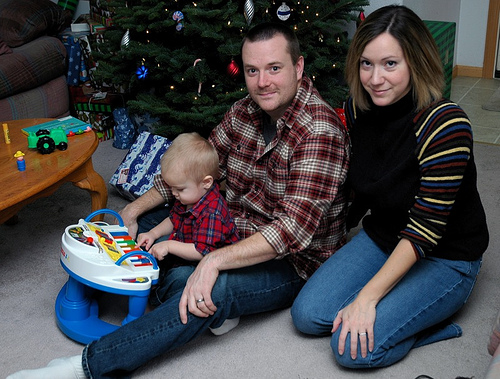
Christmas morning. I wear that damn sweater every year.
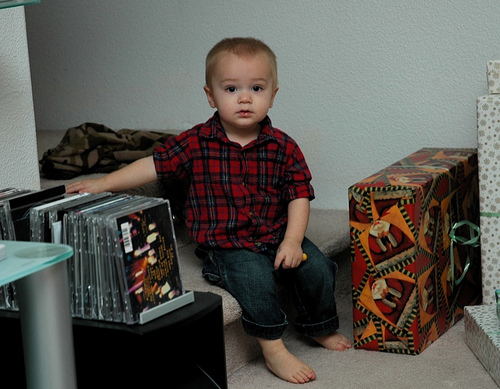
How you doin’?

Crazy-huge waves on the coast at Shore Acres park. That’s JB standing at the edge of the cliff.

More giant waves, captured while we stood there getting soaked with saltwater.
I’ve mentioned before that JB’s brother Joe is a funeral director; well, on Sunday he got a call and I found myself asking if he’d mind if I watched him work. I’m pretty sure this is the first time anyone has ever made that request to Joe, and he was more than happy to oblige, so I came along to the funeral home and watched him embalm the body of an elderly woman. It was really interesting and creepy and I’m going to post a whole entry detailing the experience, which I will give you fair warning about in case that’s not the sort of blog-reading you signed up for.
So there’s that to look forward to, here at sundrymourning.com (what do you mean you are not on TENTERHOOKS), and my now-annual New Year’s meme/thing, which I am hoping you participate in on your own website. Here are the questions, and if you post your own answers please let me know so I can link to you.
1. What did you do in 2006 that you’d never done before?
2. Did you keep your new year’s resolutions, and will you make more for next year?
3. Did anyone close to you give birth?
4. Did anyone close to you die?
5. What countries did you visit?
6. What would you like to have in 2007 that you lacked in 2006?
7. What dates from 2006 will remain etched upon your memory, and why?
8. What was your biggest achievement of the year?
9. What was your biggest failure?
10. Did you suffer illness or injury?
11. What was the best thing you bought?
12. Whose behavior merited celebration?
13. Whose behavior made you appalled and depressed?
14. Where did most of your money go?
15. What did you get really, really, really excited about?
16. What song will always remind you of 2006?
17. Compared to this time last year, are you:
a) happier or sadder?
b) thinner or fatter?
c) richer or poorer?
18. What do you wish you’d done more of?
19. What do you wish you’d done less of?
20. How will you be spending Christmas?
21. Did you fall in love in 2006?
22. How many one-night stands?
23. What was your favorite TV program?
24. Do you hate anyone now that you didn’t hate this time last year?
25. What was the best book you read?
26. What was your greatest musical discovery?
27. What did you want and get?
28. What did you want and not get?
29. What was your favorite film of this year?
30. What did you do on your birthday, and how old were you?
31. What one thing would have made your year immeasurably more satisfying?
32. How would you describe your personal fashion concept in 2006?
33. What kept you sane?
34. Which celebrity/public figure did you fancy the most?
35. What political issue stirred you the most?
36. Who did you miss?
37. Who was the best new person you met?
38. Tell us a valuable life lesson you learned in 2006.
39. Quote a song lyric that sums up your year.
Okay, enough housekeeping for now. I’ll be posting this week over here (mmm, contractually-obligated frequency), so come say hi.
-
My product review site:

 [
[